Impact of the South Kivu Voluntary Principles Working Group in the Democratic Republic of the Congo
Local inhabitants of an artisanal mining zone in the region of Bitale extract minerals on the mining site. They had been self-organised as a cooperative, but lacked formal status and legal authorisation from the authorities. When a neighbouring, formally recognised cooperative claimed mining rights to the site, the local inhabitants resisted. Violent clashes erupted, resulting in a serious security and human rights incident. The second cooperative had hired elements of the Congolese army to establish its presence on the site through the use of force. The local inhabitants, including former Mai-Mai militia members, fought back.
To prevent further security incidents, public authorities suspended all mining operations on this artisanal zone. As a result, the local mining communities lost their main source of livelihoods. Subsequently, the hired armed forces moved away from the closed site and established their presence in the adjacent mining town, illegitimately taking over policing functions and abusing their position of power. Local community members alleged that when faced with resistance by the local population, these forces were responsible for harassment, extortion and, in some cases, torture. The formally recognized cooperative took their claim of mining rights to the provincial court in Bukavu. The court, however, did not settle the dispute between the two cooperatives.
The working group’s solution
After the court failed to settle the dispute, a representative of the formally recognized cooperative approached the South Kivu Voluntary Principles Working Group to seek an alternative dispute resolution. The working group discussed this case in its monthly multi-stakeholder meetings—involving key actors from public authorities, companies and civil society—and agreed to attempt to facilitate a resolution. It conducted fact-finding missions to obtain an independent and neutral understanding of events to inform their interventions.
At the provincial level, the in-country working group:
- Informed the commanding general of the local armed forces of the alleged human rights violations and persisting risks stemming from the troops’ presence around this artisanal mining zone.
- Advocated successfully for the immediate withdrawal of the military troops illegally present in the mining site and mining town.
- Called for the deployment of the national Congolese Mining Police to the mining site and adjacent town.
At the local artisanal mining zone, the in-country working group:
- Monitored the withdrawal of the illegal army troops from the mining town and accompanied the troops back to the provincial capital in Bukavu.
- Mediated a mutually acceptable agreement between the two disputing cooperatives. According to this agreement, the legally authorised cooperative gained the extraction rights and agreed to provide the local communities with adequate compensation for their previous investments.
L'une des trois étude de cas mettant en évidence les solutions multipartites trouvées par le groupe de travail sur les principes volontaires basé au Sud-Kivu entre 2019 et 2020 à : Bitale - L'insécurité a augmenté sur le site minier de Bitale après que des coopératives minières ont engagé des éléments des FARDC pour défendre leurs revendications, obligeant les autorités publiques à suspendre les opérations minières. Le tribunal provincial de Bukavu n'a pas été en mesure de régler le différend. Le groupe de travail a toutefois pu intervenir et faciliter une résolution en menant une mission d'enquête pour avoir une appréciation indépendante de la situation. Le groupe a assuré le suivi avec le général commandant et a plaidé pour le retrait des troupes stationnées illégalement sur le site minier et dans la ville adjacente. Le GdT a surveillé le retrait qui a suivi et a servi de médiateur pour un accord mutuellement acceptable entre les deux coopératives. L'intervention du GdT a conduit au retrait des éléments de l'armée. L'accord négocié entre les acteurs de l'industrie minière a empêché de nouvelles violations des droits de l'homme et a permis la reprise de l'extraction artisanale et à petite échelle.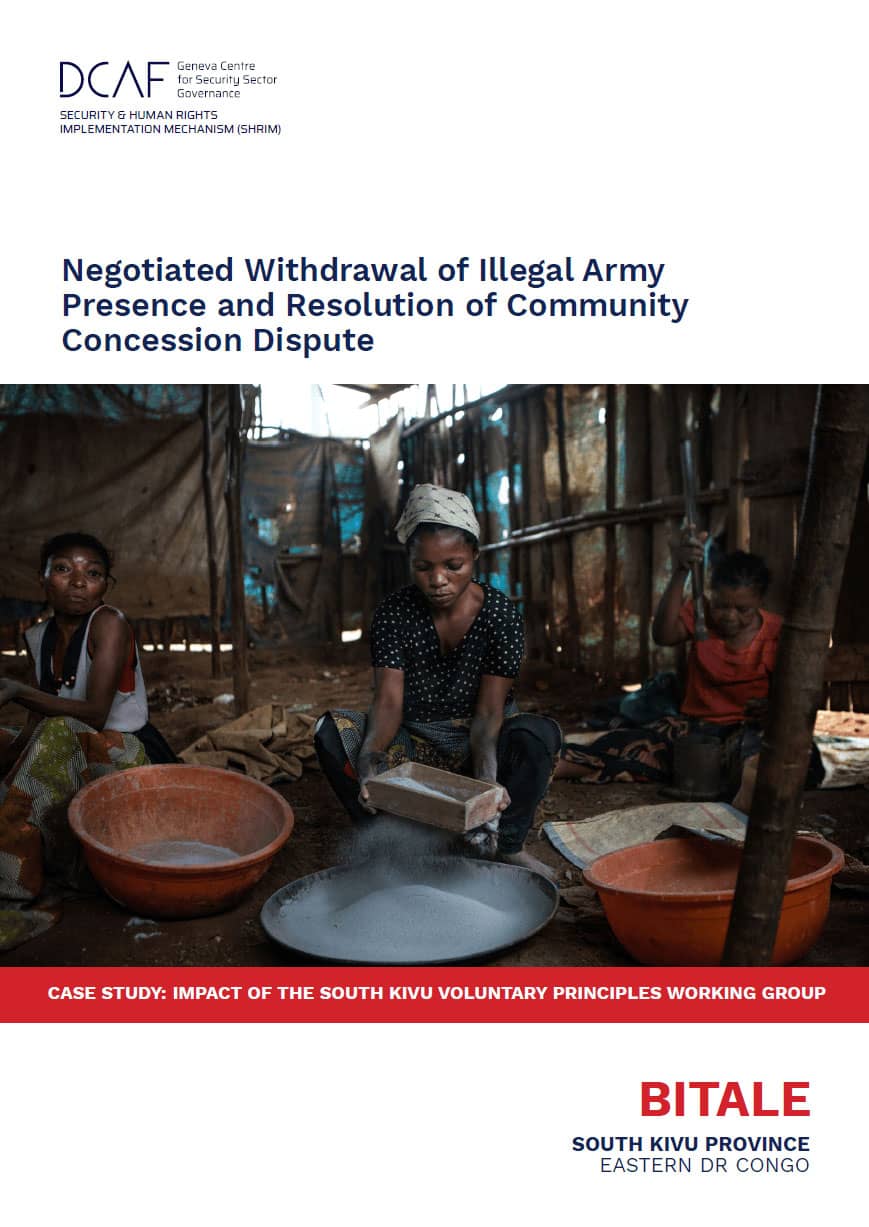
Études de cas en RDC - Bitale
Description
PDF(s)
Type de ressource