Conflict Prevention Tool
Developing Multi-Stakholder Strategies
Description
The Conflict Prevention Tool (CPT) was developed through a collaborative partnership of international experts, as an innovative framework for conflict management and resolution in relation to business operations.
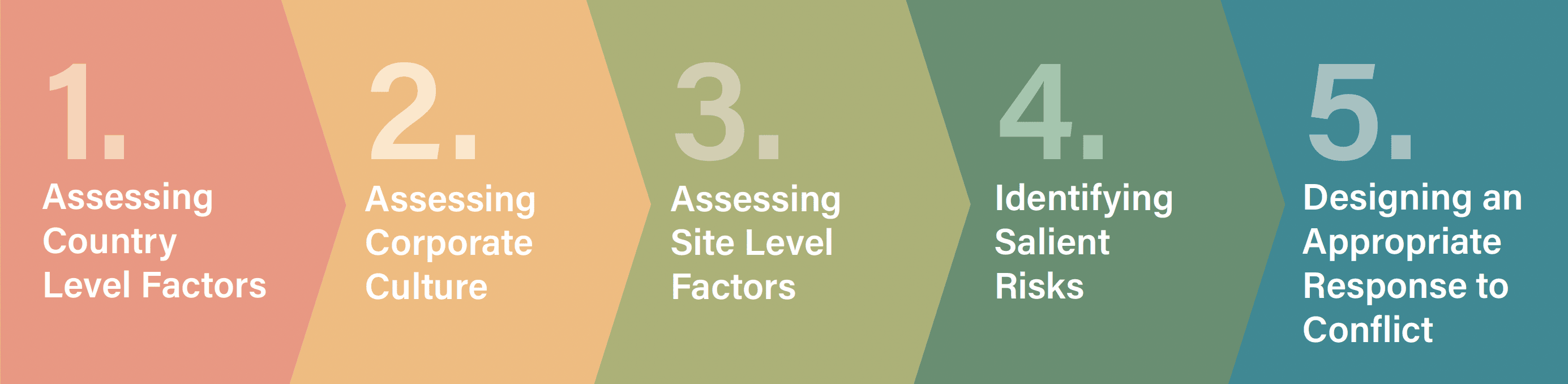
The overarching goal is to equip companies to proactively identify, analyze, and mitigate conflict-related risks. The CPT is therefore designed with a multi-layered approach in mind, focusing on identifying and analyzing risk indicators at three levels: country, corporate, and site.
The CPT supports the collection and synthesis of data gathered from a combination of desktop research and field-based consultations, leading to a practical measurement of conflict drivers to inform responsible stakeholder engagement for businesses operating in conflict-prone areas.
A key feature of the CPT is in integrating a conflict prevention mindset across all company functions, fostering proactive risk identification and mitigation, with greater social awareness and responsibility. This is achieved by encouraging different teams within a company – such as enterprise risk, security, sustainability, human resources, procurement, and operations – to collaborate in conflict analysis, thereby ensuring a proactive risk management process, which can potentially reduce the direct and indirect costs of conflict on a company.
Five Steps to Assess and Prevent Conflict
What is the Value-Added of this Tool?
-
Helps companies establish clear priorities to better manage the risks of conflict that are either independent from or linked to their operations.
-
Promotes a conflict sensitive approach and offers a pathway to develop multi-stakeholder engagement strategies (including both internal processes and external actors) that ensure a proactive, rather than reactive, risk management stance.
-
Reduces the direct and indirect costs that conflict imposes on a company, including: the increased cost of protecting staff and property, potential damage to the company’s reputation, higher payments to security firms, the weakening of social capital, and resource degradation.
-
Favours a conflict prevention mindset across company functions through greater social awareness. Integrating corporate culture as suggested in the present tool has not been done in existing conflict analysis tools and produces a more accurate and complete picture.
-
Supports companies in meeting their due diligence obligations related to security and human rights and reinforces implementation of the United Nations Guiding Principles on Business and Human Rights and Voluntary Principles on Security and Human Rights.
-
Encourages different teams to work together in analyzing conflict (e.g. security function, human resource department, procurement department, community and social performance function, operations, etc.).
-
Guides companies and professionals in their efforts to anticipate, prevent, and manage conflict, through a combination of desk-based and site level data collection, supported by questionnaires.